



2026 Council of Delegates, 3 – 4 December, Geneva
United for Humanity
A timely call to strengthen cohesion and sharpen the focus as the International Red Cross and Red Crescent Movement navigates complexity and mobilizes to continue delivering principled, impactful humanitarian action
As we face an increasingly challenging humanitarian landscape that tests the collective capacity of the International Red Cross and Red Crescent Movement (Movement) to respond, the 2026 Council of Delegates (CoD) stands as a pivotal moment to reconnect, to share and to drive forward the initiatives that will position National Societies, the ICRC and the IFRC as a stronger, more unified Movement, able to continue delivering assistance to those affected by conflicts, disasters and other crises.
In this context, and in recognition of the importance of these discussions and the valuable feedback provided by National Societies on the concept note and the draft provisional agenda, the Joint Organizing Committee and the Standing Commission have prepared a provisional agenda for adoption at the CoD.
In this context, and in recognition of the importance of these discussions and the valuable feedback provided by National Societies on the concept note and the draft provisional agenda, the Joint Organizing Committee and the Standing Commission have prepared a provisional agenda for adoption at the CoD.
Provisional agenda
The CoD agenda is organized around two complementary pillars: a decision pillar and a discussion pillar.
Decision pillar
The decision pillar focuses on resolutions that translate shared concerns into collective action.
There are five proposed resolutions to be adopted at the CoD:
Please visit the 2026 CoD document page to view the draft resolutions and their accompanying background documents.
Discussion pillar
The discussion pillar is structured around the commission “Addressing the present: Shaping the Movement of the future” and its six spotlight sessions, which will focus on the need to:
For detailed information, please visit the Commission and Spotlight Sessions page.
Decision pillar
The decision pillar focuses on resolutions that translate shared concerns into collective action.
There are five proposed resolutions to be adopted at the CoD:
- Principled and accountable use of information and communication technologies in humanitarian action
- Strengthening the resilience of urban communities – Principles of Action
- Building the Movement’s strategic and operational preparedness to address harmful information in humanitarian settings
- Reinforcing the mandate and capacities of National Societies through strengthening their legal base
- Preserving humanity: Our collective efforts to uphold international humanitarian law
Please visit the 2026 CoD document page to view the draft resolutions and their accompanying background documents.
Discussion pillar
The discussion pillar is structured around the commission “Addressing the present: Shaping the Movement of the future” and its six spotlight sessions, which will focus on the need to:
- place affected populations at the centre by delivering collective and principled humanitarian action, always driven by the Fundamental Principle of Humanity
- stand united, complementary in our mandates and coordinated in our actions, with National Societies at the centre, leveraging the full potential of local-to-global capacities and increasing our interoperability and collective efficiency
- invest sustainably in conflict, disaster, emergency and crisis preparedness to be ready to respond in an increasingly volatile environment
- uphold and promote international humanitarian law as a common good of humanity
- leverage the opportunity to strengthen the international legal framework for disaster risk management through a treaty on the protection of persons in the event of disasters
- ensure the safety and security of our personnel and volunteers by addressing evolving physical, psychological, cyber and technology‑related threats to humanitarian personnel
For detailed information, please visit the Commission and Spotlight Sessions page.
Informal programme
To further promote unity, partnership, collaboration and meaningful interactions among the components of the Movement, the CoD provides dedicated spaces, platforms and channels through:
- Side events
- Networking spaces
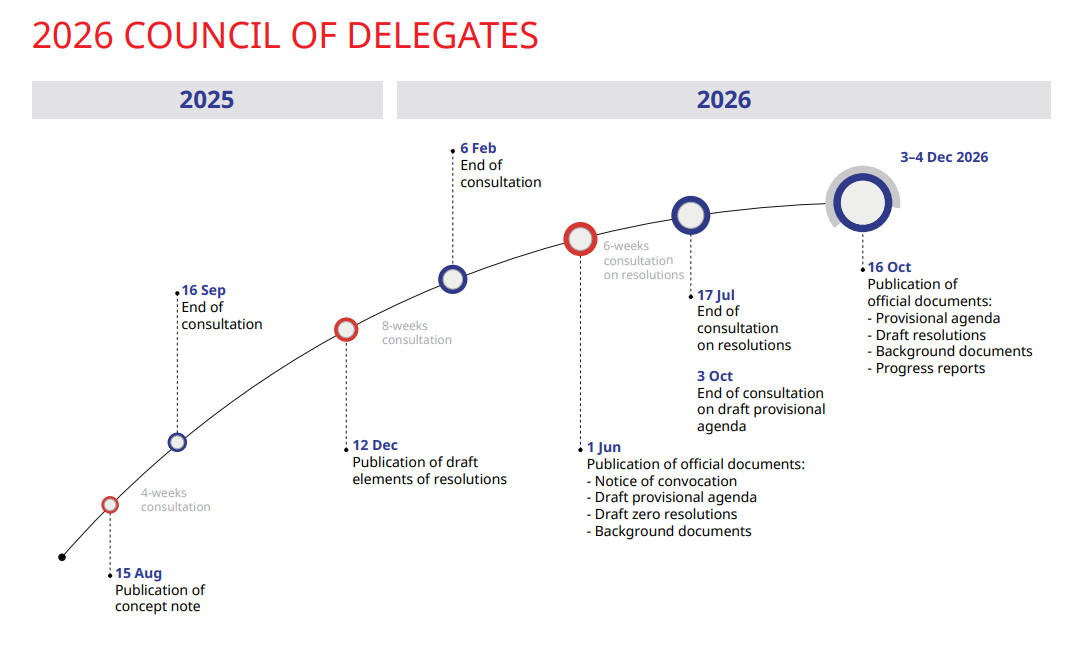
Engagement timeline
Together for an environmentally sustainable event – Contribute meaningfully to global climate action
Aiming to deliver a more environmentally sustainable event for the 2026 CoD, the IFRC/ICRC Joint Organizing Committee is implementing the recommendations set out in the Guidance for more environmentally sustainable events.This includes introducing a range of sustainability measures to reduce the environmental impact of the event, such as collecting travel-related carbon emissions data, using recycled and recyclable materials and limiting printed materials.
The information collected will help to establish a baseline for measuring the environmental sustainability of events and support further reductions in their environmental footprint.
We count on your cooperation and support in our collective effort to make our events more environmentally sustainable.
Further information will be provided in due course.
Accessibility
The Joint Organizing Committee of the CoD is committed to providing an inclusive and accessible conference environment, enabling people with disabilities to participate fully.
Participants with specific accessibility requirements are invited to indicate their needs during registration, including wheelchair access, sign language interpretation, video captioning, and large print or Braille.
Should you have any accessibility-related questions or wish to discuss specific requirements, please contact event.support@ifrc.org.