



Two years in: Progress, challenges and what comes next for the Movement’s Migration Strategy
By the IFRC and the ICRC
Against this backdrop, senior leaders from 17 National Societies, the IFRC and the ICRC convened in Geneva on 21–22 April for the first in-person meeting of the Migration Leadership Group since the adoption of the Movement Migration Strategy 2024–2030 by the Council of Delegates in October 2024.
This was not a moment for complacency; it was a moment to take stock honestly, reinforce collective commitment and agree on what the Movement needs to do differently and better.
Nearly two years on, the Migration Leadership Group (MLG)[iii] gathered in Geneva on 21–22 April for its first in-person meeting since these milestones to take stock of implementation, address changes in the humanitarian landscape and chart a course towards the 2026 Council of Delegates.
Shifts in human mobility contexts
The humanitarian backdrop today is sobering. At the MLG meeting, representatives from UNHCR, IOM and the Steering Committee for Humanitarian Response described a global landscape marked by the erosion of multilateralism, major funding cuts disproportionately impacting local actors and mixed movement routes that are shifting and becoming longer and more dangerous. The dehumanization of asylum and migration discourse, coupled with the normalization of conflict and the growing strain on respect for international humanitarian law, is creating conditions in which principled, people-centred and collaborative humanitarian action is both more needed and more difficult to sustain.
Where does the Movement stand?
In this context, National Society leaders and ICRC and IFRC representatives gathered to reflect on opportunities and progress in the implementation of the Movement Migration Strategy since its adoption, examining key insights from the 2026 Movement Migration and Displacement Survey. A total of 95 National Societies from all regions participated in this comprehensive internal survey, which revealed encouraging trends. Across the world, National Societies consistently provide essential support to migrants, including humanitarian assistance, protection, health services, information and psychological support. In addition to showcasing these achievements, the survey results also highlighted opportunities for growth, underscoring the Movement’s ability to adapt and strengthen its impact. While varying levels of institutional capacity were observed within regions, for instance, discussions emphasized the potential for further cross-border cooperation on capacity-building efforts and peer-to-peer exchanges, harnessing the complementary strengths of National Societies and demonstrating the value of the Movement’s diversity. Additionally, National Societies’ unique proximity to communities and their deep local roots offer opportunities to enhance accessibility, improve feedback mechanisms and foster the meaningful participation of migrants.
Strengthened commitment and action
Concrete examples of progress within the Movement illustrate its constant endeavour to promote cross-border collaboration. One recent example is the adoption of an extensive plan of action by the Regional Network on Migration of the Americas and the Caribbean (REDMAC), setting out how National Societies, in collaboration with the ICRC and the IFRC, can work together at the regional level to address humanitarian crises that put the life, wellbeing and dignity of migrants at risk. At the International Migration Review Forum (IMRF) held in New York in May this year, the IFRC, the ICRC and the National Societies of Colombia, Italy, the United Kingdom, Denmark and Sweden represented the Movement as a unified front, urging states to commit to and take decisive action on Objective 8 of the Global Compact for Migration. As part of this workstream, the IFRC and the ICRC, working alongside UNHCR and IOM within the United Nations Network on Migration, contributed significantly to the drafting of the United Nations Secretary-General’s recommendations on saving migrants’ lives. These examples reflect the Movement’s steadfast commitment to addressing the complex challenges faced by migrants and their families and ensuring that no one is left behind.
Looking towards the 2026 Council of Delegates
As the MLG continues to provide strategic guidance on the implementation of the Movement Migration Strategy and with the technical support of the Global Migration Task Force,[iv] the 166 National Red Cross and Red Crescent Societies working on migration, the IFRC and the ICRC remain committed to ensuring that the Strategy is translated into sustained impact. In a world where principled humanitarian approaches are more crucial than ever, the Movement looks towards the 2026 Council of Delegates to highlight the transformative impact of our work alongside and in support of migrants.
[ii] Migration Strategy for the International Red Cross and Red Crescent Movement 2024–2030: Background Document, September 2024.
[iii] The Migration Leadership Group includes senior leaders from the IFRC, the ICRC and National Societies. It provides leadership and influences the relevant executive bodies of the Movement by offering strategic advice on migration and ensuring that the Movement’s work and advocacy are fit for purpose.
[iv] The Global Migration Task Force brings together all National Society migration focal points globally and works to facilitate cross-regional collaboration. It ensures guidance and recommendations from the Migration Leadership Group are put into practice.
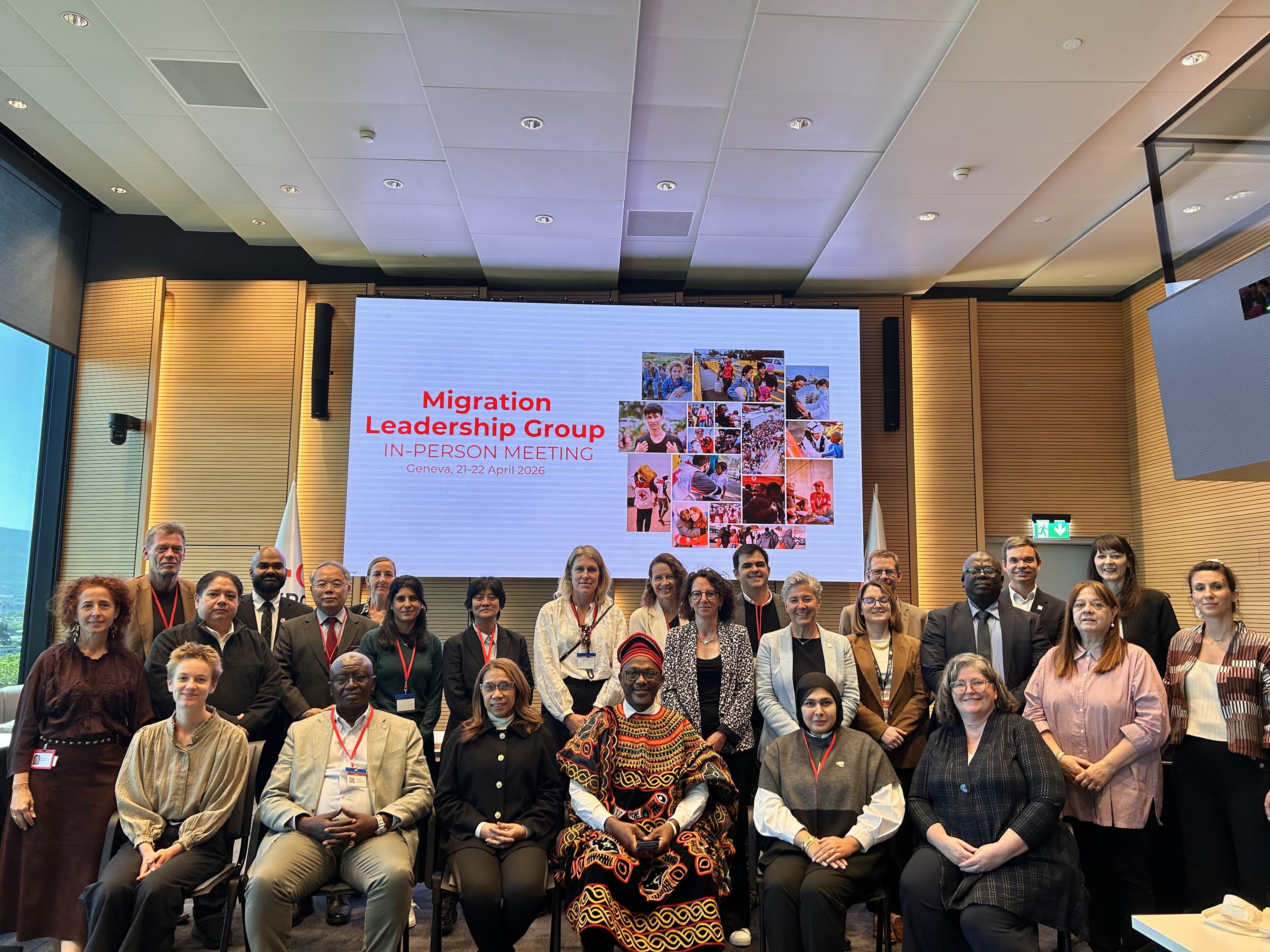
The Migration Leadership Group at the in-person meeting held in Geneva on 21–22 April 2026
Read more about this topic
- Migration Strategy for the International Red Cross and Red Crescent Movement 2024–2030
- Blog post – The first-ever Movement Migration Strategy
- Global Migration Lab, Australian Red Cross (research conducted within the Movement)
- Global Compact for Migration – UNSG recommendations on saving migrants’ lives
- 2026 IMRF Progress Declaration
The International Committee of the Red Cross, the International Federation of Red Cross and Red Crescent Societies, and the Standing Commission of the Red Cross and Red Crescent, in its function as Trustee of the International Conference of the Red Cross and Red Crescent (the Conference), cannot be held responsible or liable in any manner for any user-generated content or posts on this Database. In the event that the Website team considers any post or content to be incompatible with the Fundamental Principles of the International Red Cross and Red Crescent Movement and/or with the objectives of the Conference, it reserves the right to remove such content.